
Plant Library
Venus Flytrap Care Guide
Dionaea muscipula
By the Plantshop.com Editorial Team · Updated · How we research · Report an error
The Venus flytrap is a carnivorous plant from the Carolinas that catches insects with snapping traps. It is not a typical houseplant: it needs strong sun and mineral-free water, and benefits from a cool winter rest (dormancy), which plants kept under strong grow lights can skip.
Buy a venus flytrap We have not yet confirmed a specialist shop listing for this plant.
Amazon links open an Amazon search, not a specific product we have tested; prices and sellers vary. As an Amazon Associate we earn from qualifying purchases. Disclosure.
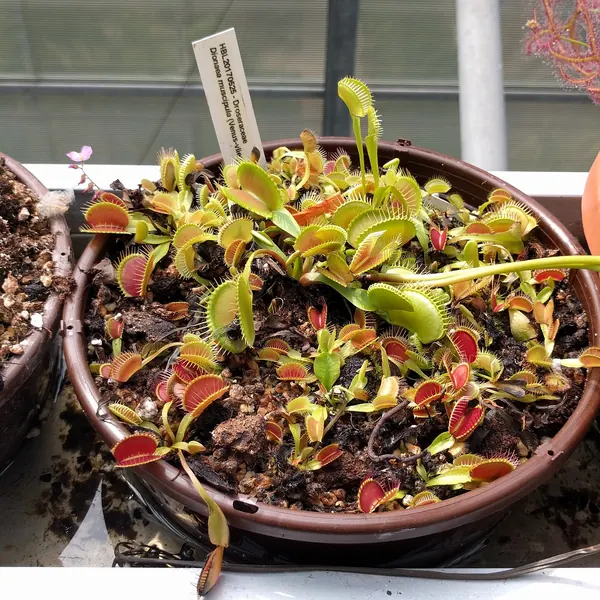
Plant profile
- Light
- Full sun: 4+ hours of direct light
- Water
- Keep wet with rainwater or distilled water only; stand in a tray
- Humidity
- High
- Pets
- Non-toxic to cats and dogs (ASPCA) [ASPCA]
- Difficulty
- Challenging
- Size
- Rosette 6-8 in across; flower stalks to about 12 in
- Growth
- Slow
Thanks, you are on the list! Open the calendar →
Light
Full sun: 4+ hours of direct light. Rotate the pot every few weeks so growth stays even.
Water
Use the tray method: grow it in a pot with a drainage hole standing in a dish of about 1/2 to 1 inch (1-2.5 cm) of water, and water by filling the dish so water seeps up into the pot. Keep the mix always moist but never soggy, and never let the dish dry out. Use only rainwater, distilled or reverse-osmosis water; tap, bottled and filtered water can kill it. Care differs during winter dormancy.
Humidity and temperature
Humidity: high. 65-75°F (18-24°C) while growing. For a winter rest (dormancy), keep it at about 35-50°F (2-10°C) for at least 10 weeks; plants under strong grow lights year-round can skip dormancy.
Soil and feeding
Plant it in a peat-based mix: whole-fiber sphagnum moss, or about equal parts sphagnum peat and coarse sand or coarse vermiculite. Never use regular potting soil or mixes with added fertilizer. Water only with rainwater, distilled or reverse-osmosis water; tap, bottled and filtered water carry minerals that can kill it. Do not fertilize. It catches its own insects; if it is indoors and catching little, you can occasionally give a trap a live insect no bigger than about a third of the trap. Never feed it meat.
Our tip
Never use tap water or fertilizer, and don't trigger the traps for fun; each trap closes only a few times.
Common problems
- Black traps: Normal after a few closures, or from tap water or low light.
- Weak, floppy growth: Not enough sun.
- Decline after a year: Often no winter rest; give it a cool dormancy (about 35-50°F) or strong year-round grow lights.
Pets
Non-toxic to cats and dogs (ASPCA), according to the ASPCA plant list. Check any plant in our Pet-Safe Plant Checker.
Ready to buy a venus flytrap? Search Amazon, or see the online plant shops we compared.
Amazon links open an Amazon search, not a specific product we have tested; prices and sellers vary. As an Amazon Associate we earn from qualifying purchases. Disclosure.
Free download
Free 12-month plant care calendar
Keeping a venus flytrap happy all year? Get our free month-by-month calendar: when to water less, when to feed, when to repot, and the seasonal notes for all 71 plants in our library.
Thanks, you are on the list! Your free calendar is ready: Open the 12-month plant care calendar →
Privacy policy — how we store emails for the calendar list.
Recommended book
The Savage Garden, Revised: Cultivating Carnivorous Plants
by Peter D’Amato
A long-standing guide to growing carnivorous plants, including Venus flytraps.
View on AmazonBook links go to the book’s Amazon page; check the price and format there. No publisher or author paid to be included. As an Amazon Associate we earn from qualifying purchases. Disclosure.